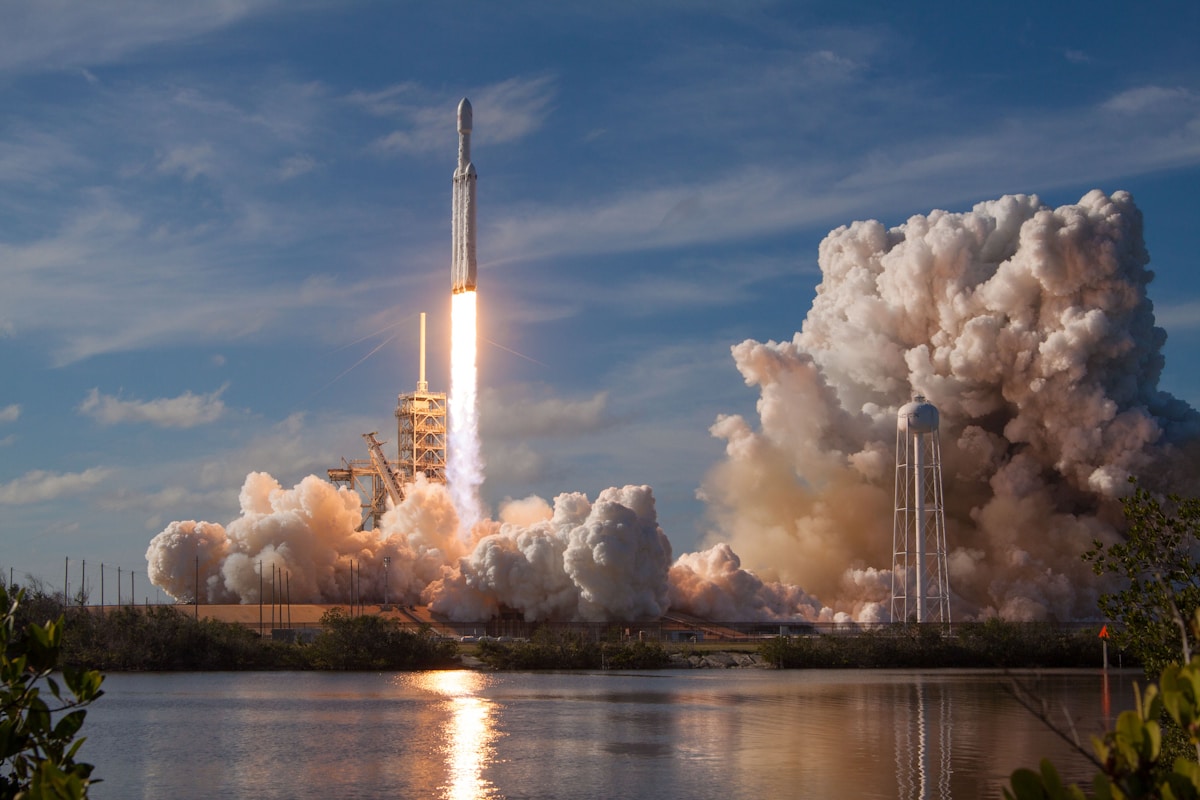
At dawn on Sunday, August 30, a SpaceX Falcon Heavy rocket thundered off Launch Complex 39A at Kennedy Space Center, carrying one of the most anticipated science missions of the decade. NASA's Nancy Grace Roman Space Telescope — a $4 billion observatory two decades in the making — is now speeding toward a point a million miles from Earth, where it will begin an audacious project: mapping the invisible forces that shape our universe.
The 7:26 a.m. EDT liftoff was flawless, and the telescope separated from its carrier roughly half an hour later, drawing cheers at NASA's post-launch press conference. For astronomers who have waited through years of budget battles and pandemic delays, the moment was decades overdue — and the science ahead may be worth every minute of the wait.
A Telescope With Hubble's Eyes and a Panoramic View
The Roman Space Telescope carries a 2.4-meter primary mirror — exactly the same size as the Hubble Space Telescope's. But the comparison ends there. Thanks to its enormous Wide Field Instrument, Roman sees a patch of sky about 100 times larger than Hubble does in a single shot, while keeping the same razor-sharp resolution.
Think of it this way: where Hubble examines the universe through a keyhole, Roman throws open the whole door. Surveys that would have taken Hubble centuries can be completed in months. That speed is the entire point of the mission.
The numbers behind the mission
- Over 1 billion galaxies will have their light measured during the five-year primary mission.
- Up to 20 billion stars will be mapped across the Milky Way.
- Roughly 100,000 exoplanets could be detected, including about 2,600 through a microlensing survey of the inner galaxy.
- 100x Hubble's field of view, with the same image sharpness.
- Three months of travel to reach its observing post at the Sun-Earth L2 point, about a million miles away.
Why Dark Energy Is the Real Target
Roman's headline job is to investigate two of the biggest open questions in physics: dark matter and dark energy. Together, these invisible components make up about 95 percent of the universe — yet scientists still don't know what either one actually is.
Dark energy is the mysterious force accelerating the expansion of the universe, a discovery that earned the 2011 Nobel Prize in Physics. Roman will attack the problem with three independent methods that cross-check one another: measuring light from Type Ia supernovae, tracking how gravity from unseen matter distorts the shapes of distant galaxies, and charting subtle patterns in how galaxies cluster, known as baryon acoustic oscillations.
If the three methods agree, cosmologists will have their tightest constraints yet on what dark energy is. If they disagree, that could be even more exciting — a sign that our understanding of gravity itself needs rewriting.
A Planet-Hunting Machine, Too
While cosmology gets the headlines, Roman may quietly become the most productive planet-finder ever flown. Its microlensing survey will watch the crowded center of the Milky Way for tiny brightening events that occur when a planet's gravity briefly magnifies the light of a background star.
This technique can find worlds that other methods miss entirely — planets orbiting far from their stars, free-floating planets drifting alone through the galaxy, and small rocky worlds in Earth-like orbits. Roman also carries a technology demonstration coronagraph, an instrument designed to block starlight so precisely that it can directly image planets around nearby stars — a rehearsal for future missions that will search for signs of life.
The Woman Behind the Name
The observatory honors Dr. Nancy Grace Roman, NASA's first chief astronomer, widely remembered as the "Mother of Hubble." In the 1960s and 70s, Roman championed the then-radical idea of putting a large telescope in space, laying the groundwork for the golden age of space astronomy we live in today. Naming NASA's newest flagship after her closes a fitting circle: the successor to Hubble's legacy carries the name of the woman who made Hubble possible.
What Happens Next
Roman's journey is far from over. Over the next three months, the spacecraft will cruise to its final orbit while engineers run its instruments through calibrations and checkouts. Key milestones to watch:
- Fall 2026: Cruise to the Sun-Earth L2 point and instrument commissioning.
- Late 2026: Final calibration and survey planning.
- Early 2027: NASA expects to release Roman's first images — the moment the public gets to see what this observatory can do.
If history is any guide, those first images will be spectacular. Hubble's deep fields and Webb's infrared vistas each redefined how we picture the cosmos. Roman's contribution will be scale: single images so vast that entire galaxy clusters, streams of stars, and hidden structures appear in one frame.
Why This Launch Matters
Beyond the science, Sunday's launch is a statement about what flagship astronomy looks like in the 2020s. A NASA observatory riding a commercial SpaceX rocket would have seemed improbable when Roman was first sketched out. Today it's routine — and it kept costs down while giving the mission a proven heavy-lift ride to deep space.
The telescope now joins Hubble and the James Webb Space Telescope in an unprecedented trio of great observatories operating simultaneously. Each sees the universe differently, and together they will cover more cosmic ground than any generation of astronomers has ever had at their disposal.
What discovery are you most excited about — the hunt for dark energy, or the search for new worlds? Share your thoughts in the comments below, and follow this blog for updates when Roman's first images arrive in early 2027.
Post a Comment