The Florida sky lit up orange on the evening of May 28, 2026, and homes in Cocoa Beach shook from the blast. Blue Origin's massive New Glenn rocket, the 29-story vehicle Jeff Bezos has poured billions and a decade of work into, erupted in flames on the launch pad at Cape Canaveral during a routine static fire test. It is being called the worst failure in the company's history—and one of the largest rocket explosions ever recorded on American soil.
The incident is more than a setback for a single launch. It reshapes the contest between Blue Origin and SpaceX at exactly the moment Bezos's team needed to prove the program could scale. Here is what happened, why it matters, and what comes next for the company, for Amazon's satellite ambitions, and for the rapidly consolidating commercial space industry.
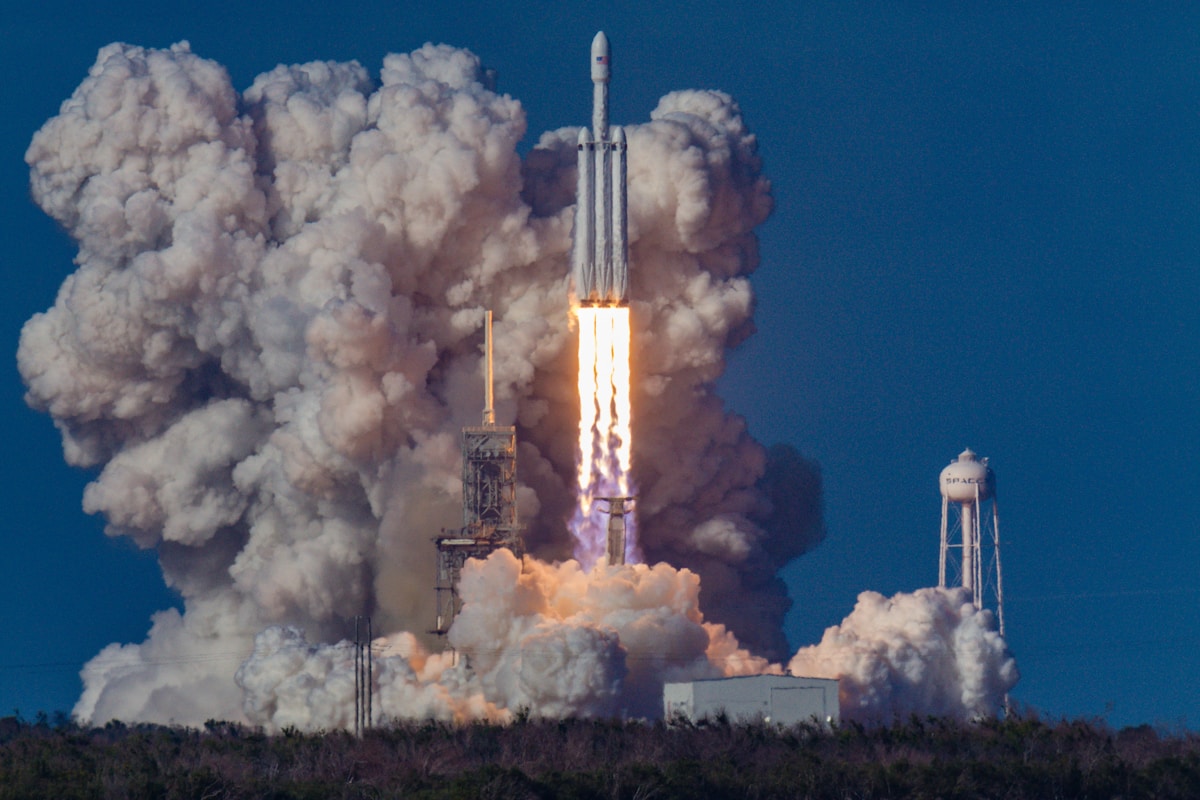
Image suggestion: rocket launch at Cape Canaveral. Source: Unsplash.
What Happened During the Static Fire Test
Blue Origin engineers were running a pre-flight static fire of the first-stage booster, internally nicknamed "No, It's Necessary," when the vehicle ignited and erupted on the pad at Cape Canaveral Space Force Station. A static fire is normally a low-risk exercise: the rocket is clamped to the ground, engines run for a few seconds, and teams collect data on thrust and combustion stability before flight.
Instead, this one ended in a fireball visible for miles. Residents reported windows rattling and a deep concussive thump rolling across the coastline. There were no reports of injuries, but the launch pad infrastructure took significant damage, and clean-up will likely keep the site offline for months.
A pattern of trouble, not a one-off
The May 28 explosion lands in the middle of a difficult stretch for New Glenn:
- November 2025: First successful orbital flight, with a clean booster landing—Blue Origin became the second company after SpaceX to recover a booster while delivering payload to orbit.
- April 2026: Third flight lost its satellite payload to a cryogenic system failure.
- May 28, 2026: Pad explosion during static fire ahead of the planned fourth mission.
Three orbital missions in 16 months of service is a slow cadence by modern standards, and the failure rate is now too high to ignore. Engineers will want to know whether the cryogenic gremlin from April and the static fire incident share a root cause—or whether Blue Origin is facing two unrelated problems at once.
Why the Blue Origin New Glenn Explosion Matters
For most of the past decade, the commercial space industry has been a one-company show. SpaceX flew 165 Falcon 9 missions in 2025 alone—more than the rest of the world combined, or roughly one launch every 2.2 days. New Glenn was supposed to be the credible second option, the rocket that would give satellite operators, defense customers, and NASA leverage in negotiations.
That story now has a very large asterisk next to it. Customers booking missions years out need confidence that the rocket will fly on time. Insurers price that risk into every launch contract. And Wall Street, which had been warming to the idea that Blue Origin could carve out durable market share, will read this as a reset.
The Amazon Kuiper problem
The most exposed customer is Amazon. The destroyed mission was meant to be the first of 24 launches Blue Origin had contracted for Project Kuiper, the low-Earth-orbit broadband network designed to compete with SpaceX's Starlink.
Kuiper already faces an FCC deadline to deploy half of its constellation, and every delayed launch chips away at the schedule. Amazon may now be forced to lean harder on alternative providers, including, awkwardly, SpaceX itself—an arrangement Amazon has used reluctantly in the past.
Image suggestion: satellite in low-Earth orbit. Source: Unsplash.
The Bezos vs. Musk Race, Recalibrated
Jeff Bezos founded Blue Origin in 2000, two years before Elon Musk started SpaceX. For most of that history, Blue Origin moved more slowly and quietly, with the tortoise-and-hare framing that Bezos himself encouraged. But in commercial space, cadence is destiny: the company that flies more learns more, lowers per-kilogram costs faster, and wins the long contracts.
The static fire explosion does not end Blue Origin's challenge to SpaceX, but it changes the timetable. Analysts who had penciled in a meaningful share-of-launch shift by 2027 will likely push those projections out. National security launch customers, who require multiple certified providers, may have to rely on ULA's Vulcan and SpaceX's Falcon Heavy for longer than they hoped.
What Blue Origin needs to do now
- Find the root cause fast. A clear, public failure analysis matters more than a quick return to flight. Customers can absorb delay; they cannot absorb mystery.
- Rebuild the pad. Cape Canaveral pad infrastructure is the constraint. The faster the pad is operational, the faster the cadence question gets answered.
- Protect Kuiper. Amazon is the anchor customer. Even partial recovery of the launch schedule preserves the most important commercial relationship Blue Origin has.
- Manage talent. Big failures test culture. Blue Origin has been hiring aggressively against SpaceX, and engineers watch how leadership responds to setbacks.
What This Means for the Broader Space Economy
Healthy markets need at least two credible providers. The commercial space sector has been edging toward that since New Glenn's first successful flight last November, but the May 28 explosion is a reminder of how fragile the duopoly hypothesis still is. Satellite operators, defense planners, and even NASA have an interest in Blue Origin recovering quickly.
The deeper lesson is about cadence. Rockets are not consumer products; they are reliability machines that get better only when they are flown a lot. SpaceX's enormous lead comes less from any single engineering breakthrough than from the compounding effect of flying so often that every component matures under real conditions.
For Blue Origin, the path forward is not glamorous. It is investigation, iteration, and disciplined return to flight. For the industry, the next several months will reveal whether the Bezos bet on slow-and-steady can survive contact with the unforgiving economics of launch.
The Bottom Line
The Blue Origin New Glenn explosion at Cape Canaveral is the company's most serious setback, and it lands at a moment when momentum mattered most. The fire is out, no one was hurt, and Blue Origin still has the funding, the engineering talent, and the customer commitments to come back. But the calendar is tighter than the team would like, and competitors are not waiting.
What do you think—does Blue Origin still have a credible path to challenging SpaceX, or has the gap become structural? Share your take in the comments, and subscribe for more reporting on the new space race as the next chapter unfolds.
Sources: CBS News, TechCrunch, Spaceflight Now, Investing.com, Aerospace Global News, Wikipedia.
Post a Comment